
How to Find Your Interior Style With an AI Room Designer
«What’s my style?» is the hardest question in decorating — Pinterest boards pile up and still contradict each other. The fastest way to answer it is to stop looking at other people’s rooms and try the styles on yours: snap one photo and an AI room designer restyles your actual room into modern, Japandi, boho, or a dozen other looks in seconds, so you discover what you love by seeing it in your own space. According to Decorilla’s guide to interior design styles, most decorating confusion comes down to mixing up a handful of closely related looks — and the quickest way through that confusion is comparison, not more scrolling.
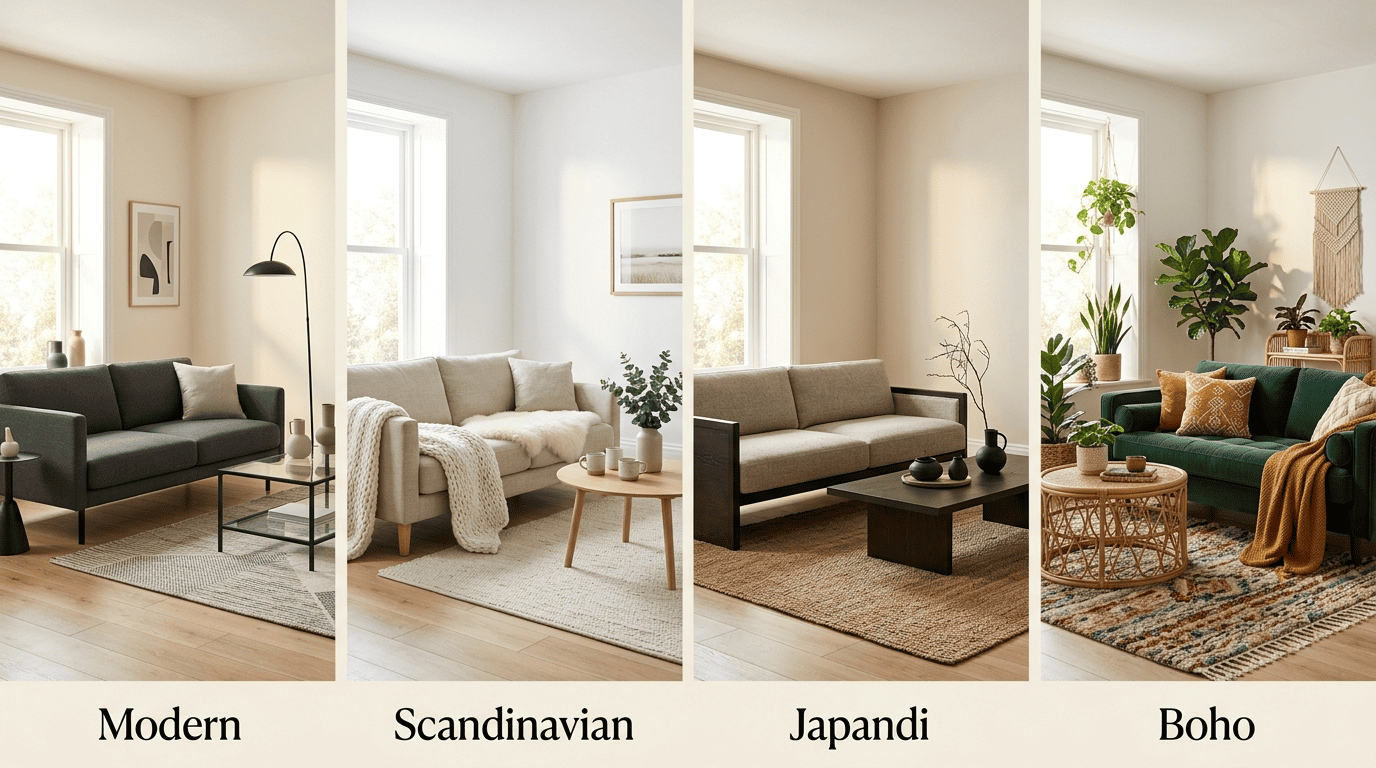
This guide breaks down the 11 styles people ask for most — modern, Scandinavian, Japandi, mid-century modern, minimalist, contemporary, boho, industrial, coastal, farmhouse, and Art Deco — how to tell the easy-to-confuse ones apart, how to blend two into a signature look, and a simple AI workflow for landing on the one that’s truly yours.
Why «trying it on your own room» beats a style quiz
Style quizzes ask what you like in the abstract; an AI room designer shows the same real room — your walls, your light, your window — restyled, so you react to a finished space instead of adjectives. It classifies structural pixels (walls, windows, doorways) versus removable ones (furniture, rugs, decor) and repaints only what you can actually change.
A quiz guesses; a render shows
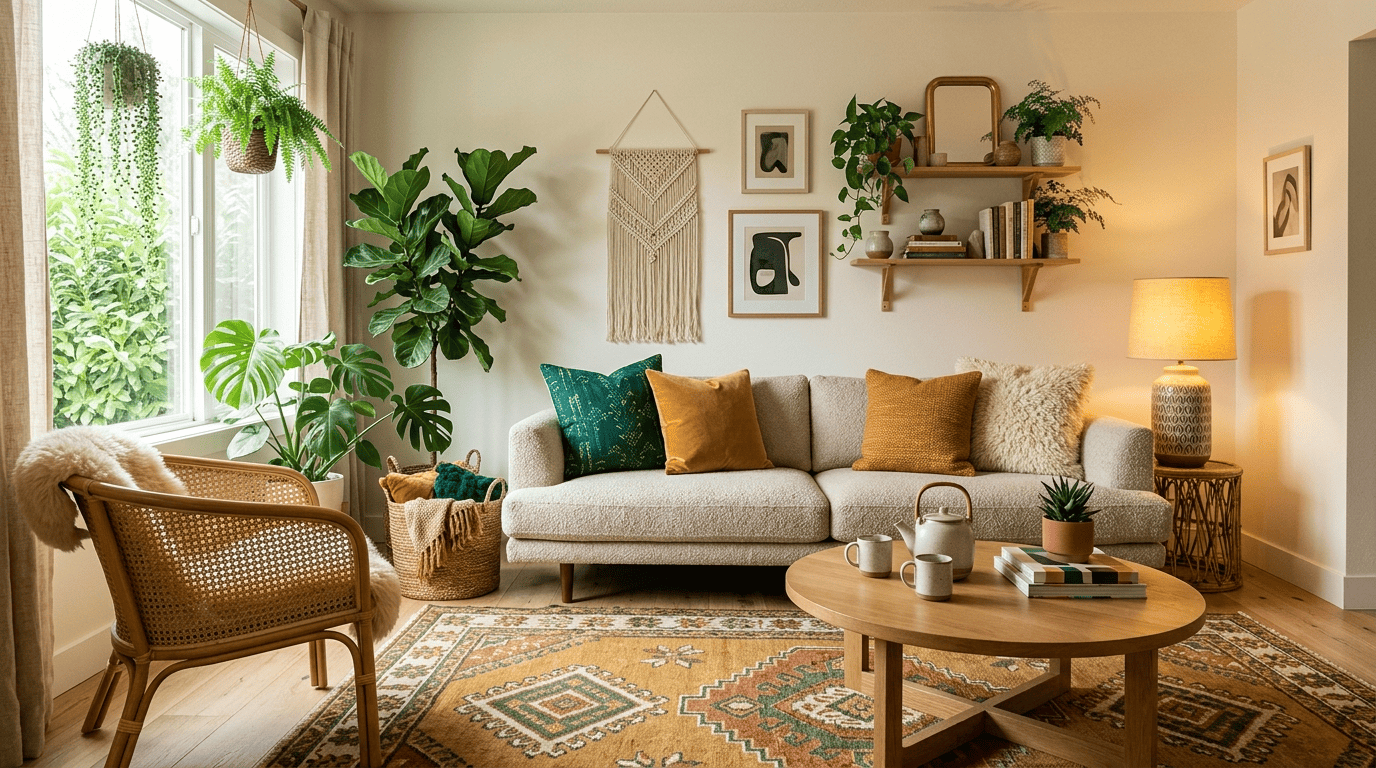
A quiz hands you a label based on a handful of multiple-choice answers. A render hands you a photo of your own living room in that label’s actual colors, furniture, and lighting — and your gut reaction to a real image is a far more reliable signal than a checkbox on «do you prefer clean lines or cozy clutter.» Generate the same room in Modern and Boho and the decision usually makes itself in seconds.
That distinction matters most for the styles people confuse on paper but never confuse in person — Modern and Contemporary read almost identically as adjectives, yet a side-by-side render makes the gap between them obvious in a glance.
Free to experiment, cheap to be wrong
Traditional per-room design work is a real financial commitment; AI removes that risk from the exploration phase entirely.
| Traditional design visualization | AI room designer | |
|---|---|---|
| Typical cost | roughly $2,000–$12,000 per room | a few dollars to free, per render |
| Turnaround | days to weeks | seconds |
| Variations you can compare | usually 1 concept | 1–4+ per style, as many styles as you want |
Because trying eleven styles costs a few minutes instead of a few thousand dollars, there’s no reason to commit to one look before you’ve actually seen it in your space.
AI renders are design ideas, not construction plans — confirm measurements, materials, and any wiring or structural/renovation work with a contractor or licensed pro before you buy or build.
The 11 styles worth trying first
Every style below has one reliable «tell» — the detail that gives it away even in a quick render, so you’re not relying on vague adjectives like «cozy» or «clean» to tell them apart.
- Modern: clean straight lines, low-profile furniture, restrained neutral palette; rooted in early-20th-century design. Tell: nothing ornate, everything intentional.
- Contemporary: whatever’s current right now — softer curves, of-the-moment tones; it shifts each decade, which is what separates it from Modern.
- Minimalist: modern taken further, where «less is more» and empty space is the feature, in a near-monochrome palette. Tell: you notice the emptiness.
- Scandinavian: pale woods, soft whites, cozy «hygge» texture, and functional simplicity, per Wikipedia’s entry on Scandinavian design. Tell: light and warm at once.
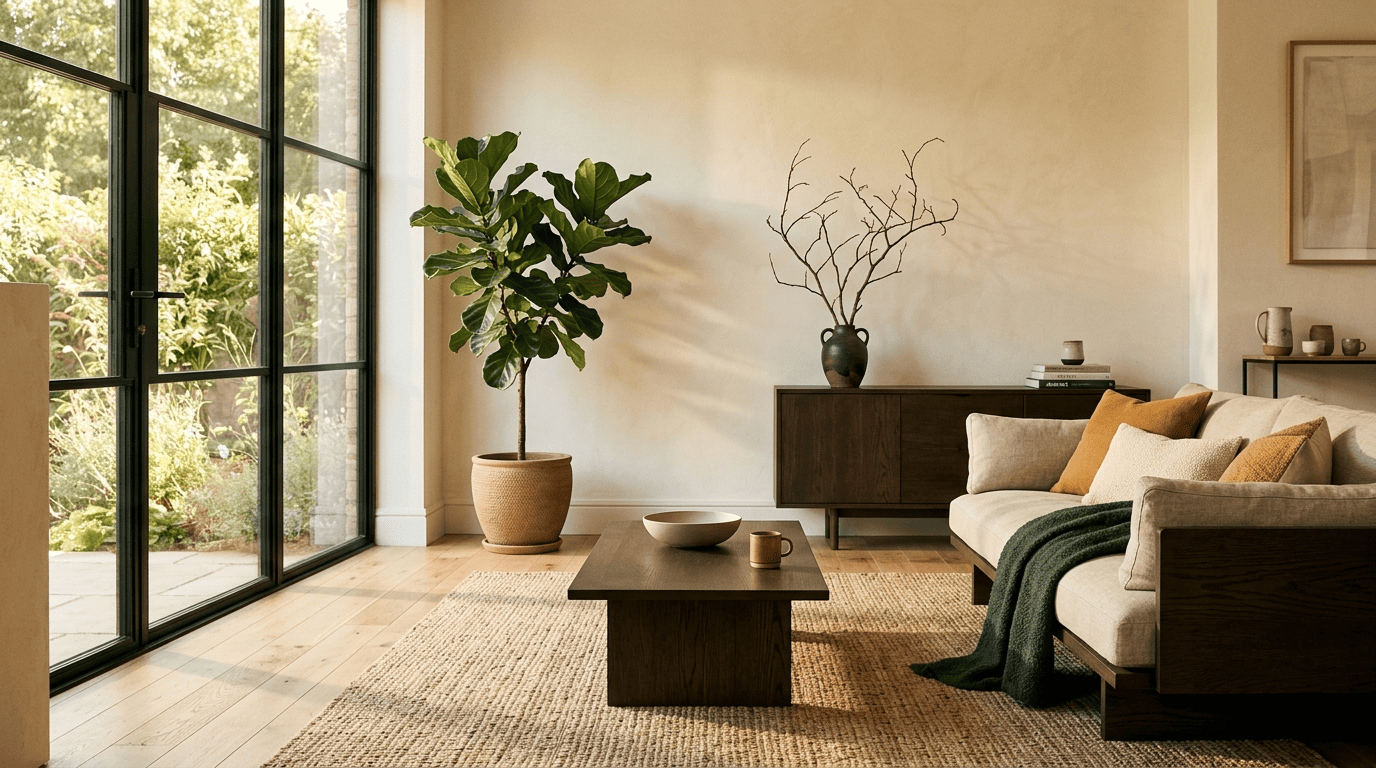
- Japandi: Scandinavian design married to Japanese wabi-sabi — low furniture, natural materials, a muted earthy palette, calm and uncluttered. Tell: Scandi warmth with darker, quieter wood.
- Mid-century modern: walnut tones, tapered legs, organic curves, and a bold accent color, with roots in the 1940s–60s. Tell: those tapered wooden legs.
- Boho (bohemian): layered textiles, rattan, plants, a warm earthy mix — «more is more.» Tell: collected, not matched.
- Industrial: exposed brick, ductwork and metal, concrete, dark neutrals, with loft-and-warehouse DNA. Tell: raw materials left visible.
- Coastal: breezy whites and blues, plenty of natural light, linen and jute, relaxed. Tell: a beach house without the seashells.
- Farmhouse (modern farmhouse): shiplap, reclaimed wood, black-and-white contrast, cozy rural-meets-clean. Tell: barn warmth with modern lines.
- Art Deco: bold geometry, rich jewel tones, brass, velvet, glamour, with roots in the 1920s–30s. Tell: drama and symmetry.
Most AI room design tools ship 30–60+ presets plus a custom text mode, so generate your room in each of the eleven above and let your gut, not a label, pick the winners.
Telling the confusing ones apart
A handful of these styles get mixed up constantly, mostly because their names sound closer than their look actually is once you see them side by side.
Modern vs. Contemporary vs. Minimalist
Modern is a fixed historical style rooted in Bauhaus-era clean lines; Contemporary is a moving target — whatever’s trending now; Minimalist is Modern pushed to the extreme, where empty space itself becomes the design. Render all three on one room and the differences stop being semantic.
| Style | Defining trait | Time reference |
|---|---|---|
| Modern | fixed set of design rules from a specific era | early 20th century, doesn’t change |
| Contemporary | reflects current trends | shifts roughly every decade |
| Minimalist | Modern reduced to its bare essentials | timeless, defined by restraint |
Once you see all three rendered on the same sofa and the same window, the labels stop overlapping in your head — Modern keeps its era-specific furniture shapes, Contemporary drifts toward whatever palette is trending this year, and Minimalist is the only one where the empty wall itself is doing the design work.
Scandinavian vs. Japandi
Japandi is literally Scandinavian design married to Japanese wabi-sabi: the same love of natural wood and simplicity, but Japandi runs darker, lower, and quieter. If a Scandi render feels too bright, try Japandi — that’s usually the style you were reaching for.
Coastal and Farmhouse get confused for a similar reason: both lean on a lot of white, but Coastal builds around linen, jute, and driftwood tones while Farmhouse leans on shiplap and reclaimed wood with heavier black-and-white contrast — generate both on your room and the material difference is unmistakable.
How AI helps you discover a signature (not just copy one)
Run your room through several of the eleven styles, then look for the repeat. Save the three renders you keep coming back to and look for what they share — a warm oak tone, a muted palette, a low level of clutter. That repeated thread is your signature style, discovered from evidence instead of guesswork. What usually repeats:
- Wood or material tone (warm walnut vs. pale ash vs. dark stained oak)
- Overall palette saturation (muted earth tones vs. bright, saturated color)
- Clutter level (collected and layered vs. spare and open)
- Texture mix (linen and rattan vs. velvet and brass vs. smooth and matte)
Pin the palette once a direction clicks. An AI room designer proposes cohesive color schemes anchored to what you can’t change, like flooring or a big sofa; the classic 60/30/10 split — dominant, secondary, accent — is a quick sanity check on any render. You can go deeper on building an AI-generated color palette once you’ve narrowed things down.
As the English textile designer William Morris put it in a line that still guides minimalist and Scandinavian thinking alike:
Have nothing in your house that you do not know to be useful, or believe to be beautiful.
William Morris
That single sentence is a decent filter for judging any AI render: if a piece isn’t useful or beautiful in the image, it probably won’t earn its place in the real room either.
Mixing two styles without it looking messy
Pick one dominant style and let a second play accent. The successful hybrids — Japandi, modern farmhouse — all follow roughly the same ratio: about 70% one style, 30% a second, held together by a shared thread like wood tone or palette. Type a custom prompt such as «mid-century modern base with boho textiles» and the AI shows the blend on your room before you commit to a single piece of furniture.
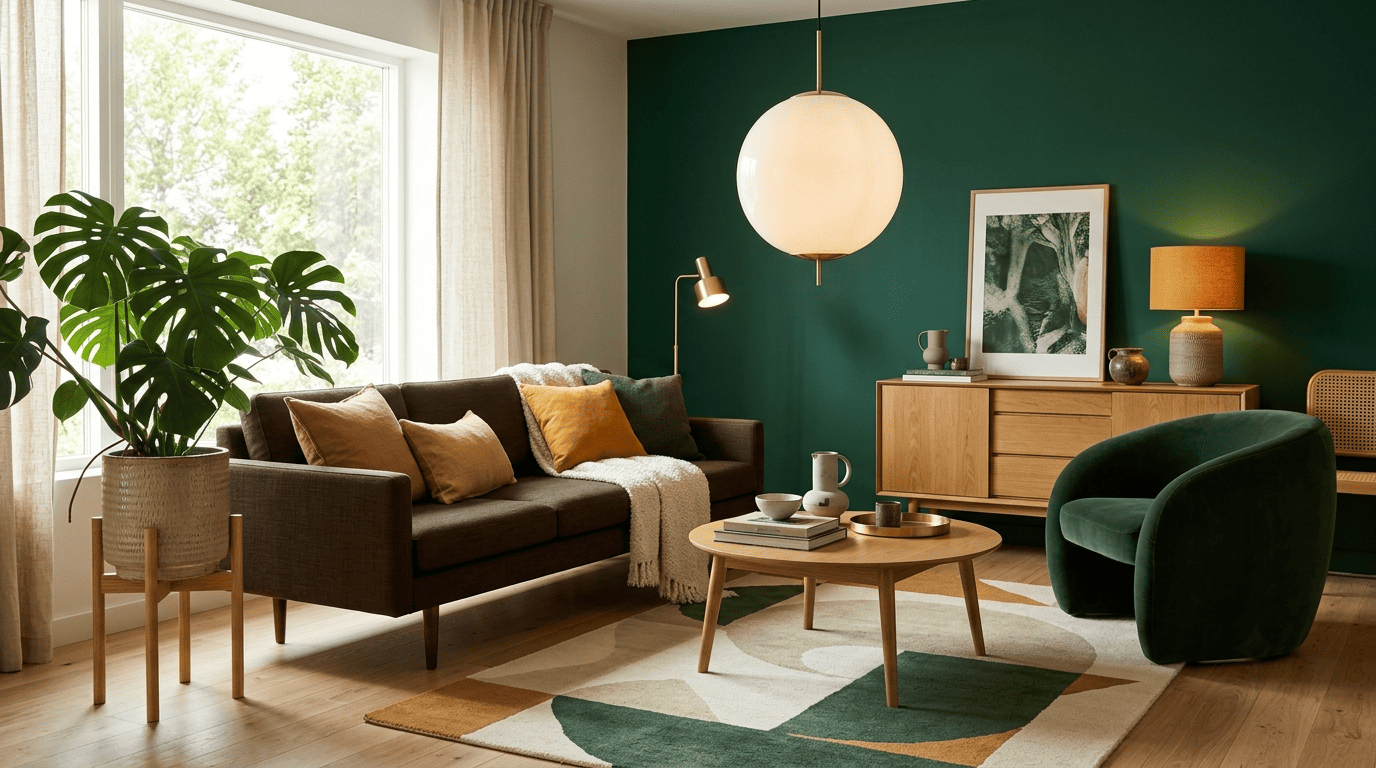
Let AI referee the mix. Because you can regenerate instantly, dial the ratio up and down — more walnut, fewer plants — until the two styles read as one intentional room instead of a collision. A few combinations that tend to work well as a 70/30 starting point:
- Mid-century modern base with boho textiles as the accent
- Farmhouse base with industrial metal fixtures as the accent
- Scandinavian base with Art Deco brass details as the accent
A 5-minute AI workflow to land on your style
Step by step
You don’t need a designer’s eye for this part — just one good photo and a willingness to compare renders side by side instead of committing to the first one that looks nice.
- Take one straight-on photo of the room in daylight.
- Generate it in six to eight presets, starting with Modern, Scandinavian, Japandi, mid-century, boho, and industrial.
- Line the results up and shortlist the two or three you’d actually live in.
- Refine the favorite with a custom prompt — swap a palette, or blend in a second style.
- Export the winner as a moodboard or shopping brief. The same one-photo approach powers every other room task, from styles to a full redesign of any room from a photo.
Five minutes of generating and shortlisting will tell you more about your actual taste than weeks of saving photos to a board, simply because you’re reacting to your own room instead of someone else’s.

Keep AI honest
Watch for anything the render «moved» that’s actually fixed — a window it widened, a wall it removed. A quick gut-check before you take any favorite further:
- Did it change window size, shape, or placement?
- Did it remove or move a wall, doorway, or outlet?
- Does the flooring or ceiling height match what’s actually there?
Explore freely with AI, then hand your favorite to a contractor or designer as a clear brief, and re-confirm measurements and any renovation work with a pro before construction starts.